
SANJAYA'S VISION
The Sixth Discipline: The Perceptual Sovereignty That Sees the Field as It Is

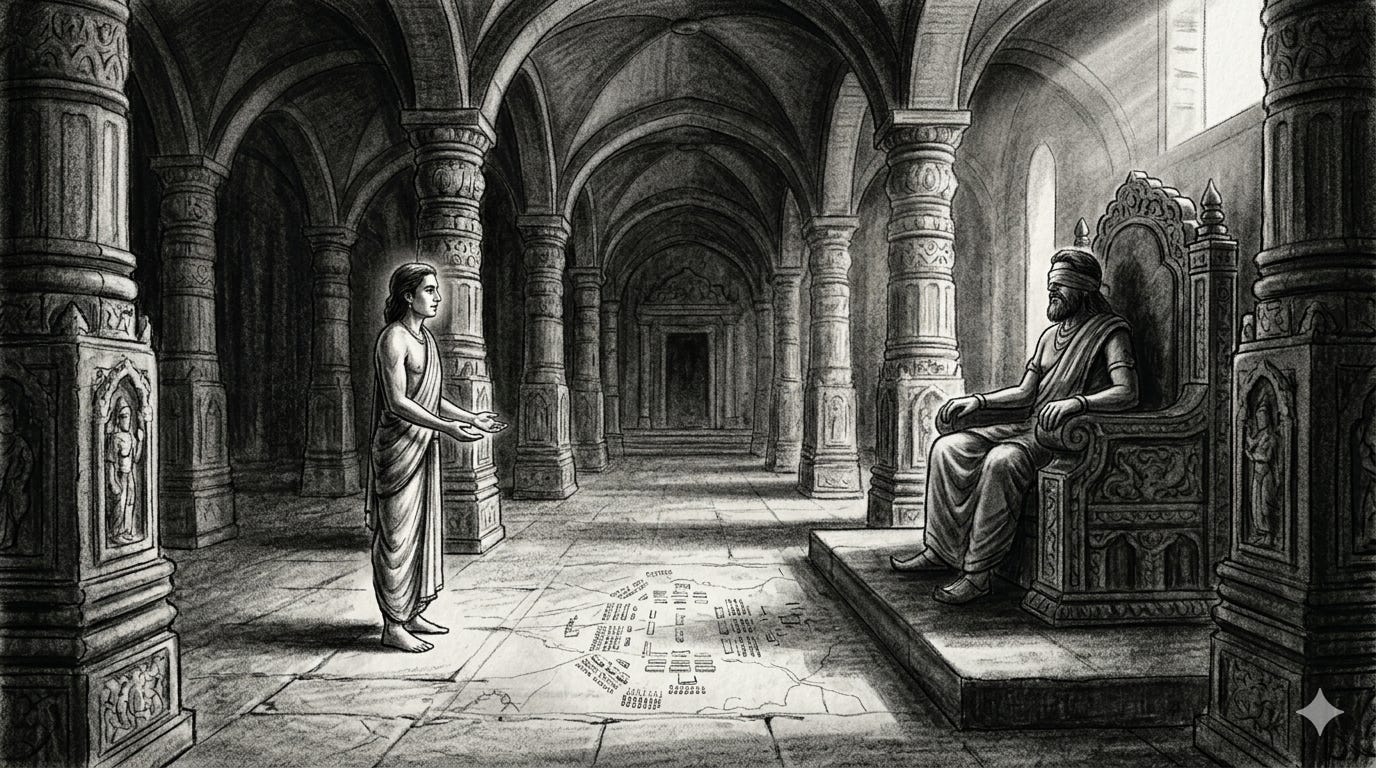
Sanjaya is not a narrator. He is the tradition’s most precise map of what happens to perception when the inner architecture is sufficiently developed that the forces engineering everyone else’s understanding of the same situation cannot determine what he sees. His Divya Drishti — divine vision — is not supernatural. It is the specific perceptual condition that becomes available when the obstacles to clear seeing have been removed. Vyasa does not give Sanjaya a power. He removes an impediment. In the AI age, which has rebuilt Dhritarashtra’s court — the blind king receiving a curated account of a battle he cannot see — at civilisational scale, Sanjaya’s function is the most urgently needed governance capacity available. And the conditions that make it possible are being systematically destroyed.
By Aman Bandvi
The Inner Architecture Series · Article XII · May 2026
OPENING FRAME
I want to describe a specific experience that I have had, with increasing frequency, over the past three years of working inside the AI governance conversation. It is the experience of reading two accounts of the same event — a deployment decision, a safety incident, a regulatory development, a research finding — and finding them so different in their characterisation of what happened, what it means, and what it requires, that it becomes genuinely difficult to determine whether they are describing the same event at all.
This is not the ordinary experience of contested interpretation — the normal condition in which different observers weight the same evidence differently based on different frameworks and different interests. That condition I have always navigated. What I am describing is something qualitatively different: the experience of encountering accounts that are not in dialogue with each other, that have not bothered to disagree with each other’s characterisation, because each one is addressed to a different audience that has been cultivated, over time, to receive a specific version of events as the obvious and complete description of what is happening.
I was in a meeting last year with a group of senior AI governance practitioners — people I respect, people who have spent years developing genuine expertise — where a significant safety incident was being discussed. Three of the people in the room had read the technical analysis. Four had read the company’s public statement. Two had read the independent researcher’s account. One had read the coverage in the specialist press. They were, nominally, discussing the same incident. They were, in effect, discussing four different events. Not because any of them was dishonest. Because the information architectures through which each had received the incident had constructed four different versions of it, each internally coherent, none of them complete, and none of them designed to make contact with the others.
Sanjaya is placed in Dhritarashtra’s palace for exactly this reason. The blind king cannot see the battle. He receives reports — from messengers, from advisors, from the institutional information architecture of a court that has its own Ahankara, its own preferred version of events, its own needs about what the battle’s progress means. Sanjaya is given Divya Drishti not so that Dhritarashtra can receive one more account. He is given it so that one person in the palace can see what is actually happening — and report it without the mediation of the architectures that are shaping everyone else’s account. The AI age has made every leader Dhritarashtra. The question is who has Sanjaya’s function, and what the conditions of that function actually require.
I. What Divya Drishti Actually Is — Before the Supernatural Reading Obscures the Practical One
The Mahabharata’s account of how Sanjaya receives Divya Drishti is precise in a way that is easy to miss if the account is read as mythology rather than as inner architecture documentation. Vyasa does not give Sanjaya a new capacity. He gives him the capacity to perceive without the specific obstacles that prevent clear perception — the vrittis, the reactive fluctuations of consciousness, the self-referential processing of Ahankara, the motivated reasoning of a mind organised around particular conclusions. The Divya Drishti is not added to Sanjaya. It is what remains when the obstacles have been sufficiently removed.
This distinction is the article’s central claim, and it is both more modest and more demanding than the supernatural reading. More modest, because it does not require the suspension of materialist assumptions about what perception is — Sanjaya is not claiming to receive information through non-physical channels. More demanding, because it specifies that the perceptual condition he achieves is the consequence of inner development rather than divine appointment — which means it is available, in principle, to any practitioner who has done the relevant work, and unavailable to any person who has not, regardless of their institutional position or their formal designation as an independent observer.
The Yoga Sutras’ account of what sustained inner development does to perception is consistent with this reading. Patanjali describes, in the later sutras, the specific perceptual capacities that become available to the practitioner whose inner architecture has been developed to particular stages: the capacity to perceive the nature of another’s mind, the capacity to perceive the distinction between objects that are ordinarily conflated, the capacity to perceive what is present without the interpretive overlay that the reactive mind consistently adds. These are not supernatural capacities in Patanjali’s presentation. They are the natural perceptual conditions of a consciousness that has reduced the interference of the DMN’s self-referential processing to the point where what is actually present can register without the distortion that the undeveloped inner architecture systematically introduces.
Sanjaya’s Divya Drishti is, in the tradition’s deepest reading, the perceptual sovereignty that this series has been building toward from its first article. It is Viveka — clear seeing — operating at its fullest development: not the occasional capacity to perceive a gap between reality and the Ahankara’s construction, but the structural condition in which the gap is the practitioner’s default relationship to experience rather than an achievement reached through effort. It is what the entire inner architecture produces when all its disciplines have been cultivated and integrated. It is, in the language of the series, the perceptual condition of the Integrated Leader — which is why this article is the penultimate one, and why what it describes is the condition from which the next article’s portrait becomes possible.
In the contemporary governance context, Divya Drishti translates to cognitive sovereignty — the individual’s and the institution’s capacity to perceive what is actually happening in the AI landscape free from the cognitive architectures that the most powerful interests in that landscape are deploying to shape that perception. Not better information. Not more rigorous analysis. The specific perceptual condition in which the information architectures that are constructing everyone else’s understanding of the situation cannot construct yours — because the inner architecture that would make their construction possible has been sufficiently developed to make it unnecessary.
◈ Consider the most significant AI governance question you are currently tracking. Now map the information architectures through which your current understanding of that question has been formed: which sources, which platforms, which social networks, which institutional relationships, which professional communities. Now ask: which of those architectures was designed, explicitly or implicitly, to produce a particular understanding of the question rather than to help you see it clearly? The answer is a description of the current state of your cognitive sovereignty — and of the distance between where your perception is and where Sanjaya’s function requires it to be.
II. The Neuroscience of Perceptual Independence — What Makes Some Perception Reliably More Accurate
The neuroscience of Divya Drishti is the neuroscience of perceptual independence — the specific neural conditions under which external framing effects, social conformity pressures, and motivated reasoning lose their dominance over what a person perceives and reports. The research on this is consistent and specific: the conditions that produce perceptual independence are not primarily conditions of character, intelligence, or domain expertise. They are conditions of inner architecture — of the degree to which the perceiver’s neural processing has been developed to reduce the specific forms of interference that the tradition identifies as the obstacles to Divya Drishti.
The most extensively studied form of perceptual interference is the framing effect — the well-documented tendency of human perception and judgment to be systematically altered by the way information is presented rather than by the information itself. The research on framing effects is humbling: even highly intelligent, highly trained, domain-expert perceivers are reliably influenced by frames that should, in principle, be irrelevant to the substance of what is being assessed. The frame is not simply decorative. It activates specific DMN associations, self-referential processing pathways, and motivated reasoning circuits that determine what information is weighted, what is discounted, and what conclusion feels obvious.
The conditions that reduce frame susceptibility — that move the perceiver toward something like Sanjaya’s perceptual independence — are the conditions that reduce DMN dominance and increase the prefrontal cortex’s capacity for deliberate, de-contextualised processing. The research on sustained attention practice, interoceptive awareness development, and what psychologists call actively open-minded thinking — the deliberate practice of seeking disconfirming information and genuinely engaging with it — shows consistent reductions in frame susceptibility, confirmation bias, and motivated reasoning. These are, without exception, the practices that the preceding articles in this series have been describing as the cultivation of Viveka, Chitta, and the inner architecture more broadly.
The neuroscience and the tradition are once again describing the same phenomenon. The practitioner whose inner architecture has been developed through sustained Abhyasa is not simply better at reasoning about the same information. Their perceptual apparatus — the neural machinery through which information is received, weighted, and integrated into understanding — is structurally different from the apparatus of the unpractised perceiver. What they receive from the same information environment is qualitatively different — not because the information is different, but because the interference that would otherwise shape its reception has been reduced. This is Divya Drishti as neuroscience: not the reception of information unavailable to others, but the reduction of the obstacles that prevent what is available from being accurately received.
The Social Conformity Dimension
The neuroscience of social conformity — the Asch experiments and their extensive subsequent literature — reveals something particularly significant for the AI governance context: the pressure to conform one’s perception to the group’s reported perception is not experienced as social pressure by most people. It is experienced as genuine perceptual uncertainty — as a reason to doubt what one has seen rather than as a reason to doubt the group. The conformity pressure does not feel like pressure. It feels like epistemic humility.
This is the specific mechanism by which the information environment of a governance room, a professional community, or an algorithmically curated information diet produces the perceptual convergence that the tradition maps as the opposite of Divya Drishti. The person who receives a version of events that most of their professional community has also received does not experience themselves as receiving a framed account. They experience themselves as perceiving the obvious — the thing that any reasonable, informed person in their position would see. The conformity has been internalised as clarity.
The neural correlate of genuine perceptual independence — of the condition in which social conformity pressure fails to alter what the perceiver reports — is high anterior cingulate cortex activation in the face of group disagreement: the specific neural signature of the person who can hold the conflict between their own perception and the group’s reported perception without resolving it in the group’s favour. This is, again, the neural correlate of the practices this series has described: the ACC activation that sustained attention practice develops is the same activation that produces resistance to social conformity pressure. Sanjaya’s perceptual independence is not a personality trait. It is the consequence of the inner architecture that produced it.
◈ In the professional communities where your understanding of the AI landscape is most significantly shaped, how often do you find yourself perceiving something different from the consensus — and how often does that different perception reach the level of expression? The gap between what you perceive and what you report in community contexts is a precise measure of the social conformity pressure operating on your perception. It is also a measure of the distance between your current perceptual condition and the one Sanjaya’s function requires.
III. The Signal and the Noise — What Information Theory Says About Seeing Through the Architecture
The information theory argument relevant to Sanjaya’s Vision is not quantum mechanical and not thermodynamic. It is the most classical of the information sciences: the problem of signal recovery from a noisy channel. Claude Shannon’s foundational insight — that the information content of a signal is inversely proportional to its probability, and that reliable communication requires the capacity to distinguish signal from the noise that the channel introduces — applies with precise relevance to the perceptual problem the AI governance moment has created.
The information environment in which most AI governance decisions are currently being made is not a channel with random noise. It is a channel with engineered noise — information architectures specifically designed, by the most sophisticated algorithmic systems and the most well-resourced institutional communications operations in human history, to reduce the signal-to-noise ratio for specific categories of information. The category of information most consistently attenuated: the accurate, complete, consequence-focused account of what AI systems are doing to the populations they are deployed upon. The category most consistently amplified: the capability-focused, benefit-emphasising, risk-minimising account that serves the deployment trajectories the architectures are designed to support.
This is not conspiracy. It is the information-theoretic consequence of deploying recommendation systems optimised for engagement in an environment where the most engaging content about AI is the content that confirms the audience’s existing relationship to the technology — whether that relationship is enthusiasm or alarm. Both the techno-optimist and the AI-doomist information architectures are noisy channels, in Shannon’s sense, for the specific signal that governance requires: the accurate, calibrated, consequence-focused account that serves neither narrative.
Sanjaya’s Divya Drishti, in information-theoretic terms, is the capacity for reliable signal recovery from an engineered-noise environment. It is not the capacity to receive information that others cannot. It is the capacity to recover the signal that the channel’s noise has attenuated in everyone else’s reception — because the inner architecture that the noise is designed to exploit has been sufficiently developed that the exploitation does not succeed. The DMN’s narrative-preference that the engagement-optimised content targets, the Ahankara’s confirmation-seeking that the algorithmically curated information diet serves, the social conformity pressure that the professional community’s consensus produces — these are the noise mechanisms. Divya Drishti is the inner architecture’s noise cancellation.
The practical governance implication is specific: in an information environment engineered to attenuate the governance-relevant signal, the quality of governance decisions is a direct function of the quality of the inner architecture of the people making them. Not their access to information — the information is, in most cases, available. The capacity to recover the signal from the noise that their information environment has introduced into its reception. This capacity is not distributed uniformly across the governance conversation. It is a consequence of inner development, and its absence is the most significant unreckoned governance risk in the current AI transition.
◈ For the three most significant AI governance questions you are currently tracking: what are the signal sources — the primary, unmediated accounts that carry the governance-relevant information in its least attenuated form? And what is the ratio of your engagement with those sources to your engagement with the secondary, curated, architecturally mediated accounts that are more accessible and more consistently present in your information environment? The ratio is a description of the signal-to-noise balance of your current perceptual conditions.
IV. The Dhritarashtra Problem — What Happens When Clear Reporting Cannot Be Heard
The Mahabharata’s most uncomfortable dimension of the Sanjaya story is not Sanjaya’s vision. It is Dhritarashtra’s reception of it. Sanjaya sees clearly. He reports accurately. He is in the room with the blind king for the entire duration of the war, providing the most precise available account of what is happening on the field. And Dhritarashtra, receiving this account, consistently interprets it through the lens of what he needs it to mean — asking questions that seek reassurance, weighting the reports that suggest Kaurava advantage, resisting the implications of the reports that do not.
This is the Dhritarashtra problem: the condition in which Sanjaya’s function is present but the consciousness that receives his reports cannot hear them accurately, because the Ahankara of the receiver is organised around an outcome that the accurate report consistently threatens. Dhritarashtra’s blindness is not only physical. His inability to see the battle directly is the external representation of the inner condition that prevents him from receiving Sanjaya’s account without the Ahankara-mediated distortion that makes the account serve his needs rather than his understanding.
The AI governance equivalent of Dhritarashtra is not a villain. It is the board that receives the safety team’s accurate report and asks the questions that seek reassurance rather than the questions that the report’s implications require. The regulator that receives the researcher’s precise account of a deployment’s consequences and processes it through the framework that makes the consequences manageable rather than the framework that makes them visible. The public that receives the journalist’s careful investigation and engages with the elements that confirm its prior relationship to the technology rather than the elements that would require that relationship to change.
The Dhritarashtra problem reveals a dimension of the cognitive sovereignty challenge that the inner architecture conversation must account for: the cultivation of Sanjaya’s perceptual function is necessary but not sufficient. The governance conversation also requires the cultivation of Dhritarashtra’s capacity to receive an accurate account — which is, in the tradition’s mapping, the same inner architecture work, applied to the receiver rather than the reporter. The Ahankara that distorts Sanjaya’s reporting and the Ahankara that distorts Dhritarashtra’s reception are the same function, operating at different points in the information chain. The cultivation of Divya Drishti is not only the cultivation of the capacity to see clearly. It is the cultivation of the capacity to receive clearly — to hear Sanjaya’s report without the Dhritarashtra processing that converts it into something the self-narrative can absorb without genuine disturbance.
The Vidura Counterpoint
The Mahabharata offers one figure who receives Sanjaya’s account — and the broader information available about the war’s trajectory — without Dhritarashtra’s distortion: Vidura. The tradition’s characterisation of Vidura is precise: he is Dharma incarnate, not in the sense of perfect virtue, but in the sense of a consciousness organised around truth rather than around the protection of a self-narrative invested in a particular outcome. He receives the same reports Dhritarashtra receives. He draws different conclusions — consistently, accurately, and at the cost of the royal relationship that his position depends on.
Vidura is the Dhritarashtra antidote: the receiver whose inner architecture allows accurate reception of the signal that the environment is attenuating for everyone else. His presence in the court, like Sanjaya’s, is the tradition’s documentation of what the governance function requires on both sides of the information exchange: the reporter who sees clearly, and the receiver who can hear what is seen. The AI governance equivalent of Vidura — the board member, the regulator, the institutional leader whose inner architecture allows them to receive the accurate safety report without the Ahankara-mediated processing that converts it into reassurance — is as rare and as urgently needed as the Sanjaya who produces it.
◈ In the information you receive about the AI landscape — the reports, the assessments, the research findings, the governance recommendations — how much of your reception is Sanjaya reception and how much is Dhritarashtra reception? How much of what reaches you accurately represents the signal, and how much has been processed through your own Ahankara’s preferred conclusions before it registers as understanding? The Dhritarashtra problem is not only a problem of the information environment. It is a problem of the inner architecture of the receiver. Both require cultivation.
V. Cultivating Divya Drishti — The Practices of Perceptual Sovereignty
The tradition’s prescription for the cultivation of Divya Drishti begins with the recognition that it is not a practice in the ordinary sense — not a technique that can be applied to the current information environment and produce clear perception within it. It is the consequence of the inner architecture that the preceding articles have been building. Viveka is its precondition. Vairagya is its enabling condition. Abhyasa is its structural foundation. Chitta is its ground. Sankalpa is its direction. Divya Drishti is what perception looks like when all of these have been sufficiently cultivated.
What this means practically is that the cultivation of perceptual sovereignty requires the full cultivation programme the series has described — not as a preparation for the perceptual work, but as the perceptual work itself. There are no techniques for Divya Drishti that bypass the inner architecture disciplines. There are only inner architecture disciplines whose cumulative consequence is a perception that the information environment cannot fully compromise.
Within that larger frame, the tradition and the neuroscience together identify several specific practices that develop the perceptual independence dimension of the inner architecture with particular directness.
Pratyahara — The Deliberate Withdrawal from the Information Architecture
Patanjali’s fifth limb of yoga — Pratyahara, the withdrawal of the senses from their objects — is the most directly applicable practice for the cultivation of perceptual sovereignty in the AI age’s information environment. In the tradition’s original context, Pratyahara refers to the withdrawal of attention from sensory stimulation as a prerequisite for the sustained inward attention that meditation requires. In the contemporary context, its most urgent application is to the information diet: the deliberate, structured, regularly practised withdrawal from the algorithmically curated information environment that is the primary shaper of most governance practitioners’ understanding of the field.
Media fasting — the deliberate suspension of all algorithmically mediated information consumption for a defined period — is the most direct contemporary form of Pratyahara available. The research on its effects is consistent with the tradition’s account of what withdrawal from the sensory architecture produces: the progressive reduction of the framing effects, confirmation biases, and social conformity pressures that the architecture has been introducing into perception, and the gradual emergence of a more direct relationship with what the practitioner actually thinks and perceives rather than what the architecture has been constructing for them.
The practice requires more than occasional digital detox — the retreat that resets and is immediately followed by re-immersion. It requires the structural restructuring of the information architecture itself: the deliberate choice of primary sources over algorithmically curated secondary ones, the maintenance of information source diversity against the personalisation pressure that every major platform applies, and the regular, protected periods of information withdrawal that allow the perceptual baseline to return to something closer to the practitioner’s actual perception rather than the architecture’s preferred construction of it.
Primary Source Discipline
The second practice is less contemplative and more immediately applicable to the governance context: the disciplined commitment to primary source engagement — the direct reading of research papers, regulatory filings, technical assessments, and incident reports in their original form rather than through the summary, characterisation, and framing that the secondary information architecture provides.
The information loss that occurs between a primary source and its secondary characterisation in the AI governance context is not random. It is systematic — the attenuation of precisely the information that is most governance-relevant and most threatening to the dominant narratives of the communities producing the secondary accounts. The researcher’s careful qualification, the incident report’s specific population data, the technical assessment’s honest uncertainty — these are consistently lost in the translation to the formats that the information architecture amplifies. The practitioner whose perceptual sovereignty requires accurate reception of this information must access it at the level at which it has not yet been attenuated.
Structured Adversarial Engagement
The third practice extends the Pratipaksha Bhavana of the Chitta article into the specific domain of information consumption: the deliberate, structured, regularly practised engagement with the most rigorous available account that contradicts the practitioner’s current understanding of a significant governance question. Not the weakest or most easily dismissed critique — the strongest, most evidence-supported, most carefully argued opposing account.
The practice requires a specific stance that is different from ordinary open-mindedness: the temporary suspension of the practitioner’s current position — not its abandonment, but its bracketing — for the duration of the engagement with the opposing account, so that the opposing account can be genuinely received rather than processed through the defensive filters that the current position activates. This is the information consumption equivalent of the Titiksha practice described in the Vairagya article: the capacity to remain present and functional inside the discomfort of genuine engagement with a perspective that threatens the current understanding.
◈ What is the most rigorous, most carefully argued account of the AI governance situation that contradicts your current understanding of it? Have you read it — in full, in its primary form, with the genuine suspension of your current position that genuine reception requires? If not: that is the precise location of the perceptual sovereignty gap that the Sanjaya practice is designed to close. The tradition does not require you to be convinced by the opposing account. It requires you to have genuinely received it.
VI. Cognitive Sovereignty as Political Dimension — The Right to See Clearly
The inner architecture conversation has been, through the preceding eleven articles, primarily addressed to the individual leader and their cultivation of the inner disciplines that governance requires. This article’s sixth section turns outward — to the political dimension that the cognitive sovereignty conversation requires and that the series has been building toward since the framework was first established in Vol 1.
Cognitive sovereignty is not only a personal inner architecture achievement. It is a political right — the right of individuals, communities, and nations to the integrity of their own perceptual conditions. The capacity to see what is actually happening, free from the cognitive architectures that powerful interests are deploying to shape that perception, is not simply a spiritual discipline. It is a governance precondition — the condition without which democratic deliberation, regulatory independence, and the informed consent of affected populations are not possible in any meaningful sense.
The AI age has created conditions in which this right is being systematically violated at scale. The recommendation systems, the information architectures, the algorithmically curated environments through which most people in most countries now receive most of their information about what is happening in the world — these are not neutral channels. They are channels controlled by a small number of entities with specific interests in specific understandings of specific situations, capable of shaping the perceptual conditions of billions of people in directions that serve those interests. This is not a claim about malicious intent. It is an information-theoretic observation about the consequences of deploying engagement-optimised recommendation systems at civilisational scale.
The tradition’s account of Sanjaya’s function — the one person in the court whose perception cannot be managed by the institutional information architecture — is, in the political dimension, a map of what cognitive sovereignty as a governance right requires: not just the individual cultivation of Divya Drishti, but the structural protection of the conditions that make Sanjaya’s function possible, and the structural challenge of the conditions that make Dhritarashtra’s distortion inevitable. The political work of cognitive sovereignty is the governance equivalent of the inner work of Divya Drishti. Both are required. Neither is sufficient without the other.
India’s Specific Opportunity and Obligation
India’s position in the cognitive sovereignty conversation is specific and significant. As the world’s largest democracy, with the world’s largest digitally connected population and a rapidly developing AI ecosystem, India faces both the greatest exposure to the cognitive sovereignty challenge and the most significant opportunity to address it in ways that the Global South’s needs and India’s own civilisational intelligence can shape.
The civilisational resource that India brings to this conversation is not primarily technical. It is the tradition that this series has been drawing on throughout — the most sophisticated available map of the inner architecture that cognitive sovereignty requires, developed over five thousand years and now independently confirmed by the neuroscience and physics that the preceding articles have documented. India’s contribution to the global cognitive sovereignty conversation is not to import the frameworks that the technologically dominant nations are developing. It is to offer the inner architecture tradition as the framework from which the governance of cognitive sovereignty can be built — and to demonstrate, in its own regulatory and governance choices, what that framework produces in practice.
The Bharat Responsible AI Forum’s work sits precisely at this intersection: the development of AI governance frameworks that draw on India’s civilisational intelligence about consciousness, perception, and the inner architecture of the decision-maker, rather than on the framework imports that carry the assumptions of the cultures that developed them. This is not cultural nationalism. It is the recognition that the governance challenge of the AI transition has an inner architecture dimension that the dominant governance frameworks have not adequately addressed, and that the tradition which has most precisely mapped that dimension has a specific and urgent contribution to make.
◈ What would it mean — specifically, operationally, in terms of regulatory choices, institutional design, and the cultivation practices built into governance culture — for India to exercise cognitive sovereignty leadership in the AI transition? Not as aspiration. As specification. The tradition’s map of Sanjaya’s function is available. The question is whether the institutions capable of building governance architecture from it will do so before the perceptual conditions of the populations they govern have been shaped by architectures built from a different map.
VII. The Leader Who Sees the Field — What Sanjaya’s Function Produces in Practice
The preceding articles have described the qualities that the inner architecture’s disciplines produce: the leader who sees clearly, who acts on what they see, whose capacities are structural, whose ground holds, whose resolve organises action, and now, whose perception the information environment cannot fully compromise. This final section before the coda attempts what the series has attempted in each closing section: the description of what the fully developed quality actually looks like in the specific conditions of the AI transition.
The first quality the Sanjaya-function produces is not what is conventionally meant by being well-informed. The leader with Divya Drishti does not necessarily have more information than the leaders around them. They frequently have less — because the discipline of primary source engagement, structured adversarial reception, and information architecture withdrawal that Divya Drishti requires is time-consuming in ways that the algorithmically curated information diet is not. What they have is different: a higher signal-to-noise ratio in what has reached them, a more accurate calibration of their own uncertainty, and a more reliable sense of where the boundaries of their actual knowledge lie — as distinct from the boundaries of what the information architecture has made them feel confident about.
The second quality is a specific relationship to consensus that is different from both conformity and contrarianism. The Sanjaya-function leader does not defer to the professional community’s consensus because the community believes it. They engage with the reasoning and evidence that produced the consensus, assess it through their own perceptual conditions, and arrive at a position that may or may not match the consensus but that is genuinely their own rather than the architecture’s construction. This does not make them reliably right — Sanjaya sees clearly, but clear seeing is not omniscience. It makes them reliably honest about what they see, which is the prerequisite for the governance function the tradition is describing.
The third quality is the most practically significant for the governance context: the capacity to perceive the war as it is rather than as Dhritarashtra needs it to be — and to report that perception to the king even when the king’s reception will be distorted, even when the report will not immediately produce the action it calls for, even when the function of reporting accurately is to create the historical record that the tradition marks as the point from which a different trajectory was still possible. Sanjaya reports the war’s progress to Dhritarashtra knowing that Dhritarashtra’s Ahankara will distort the reception. He reports it anyway. The report is not for Dhritarashtra alone. It is for everyone who will read the Mahabharata and need to understand, with precision, what happened and why.
The AI transition is producing its own Mahabharata — a record of decisions made, warnings given, courses maintained, and corrections deferred that future readers will examine with the same precision that the tradition brought to the Sabha, the forest, the exile, and the war. The question for the people currently inside that record is whether they are playing Sanjaya’s role or Dhritarashtra’s — whether they are perceiving the field as it is and reporting it clearly, or receiving accurate accounts through an Ahankara that processes them into something the self-narrative can absorb without genuine disturbance. The tradition offers no comfort about which role is more comfortable. It is precise about which role is more consequential.
The leader whose Divya Drishti is functional does not make the governance conversation easier. They make it more honest — which is, in most governance rooms at most moments in the AI transition, significantly more uncomfortable than easier. The Sabha did not want Draupadi’s question. Ravana did not want Vibhishana’s counsel. Dhritarashtra did not want Sanjaya’s accurate account of what was happening to his sons. The tradition marks each of these resistances as a precise description of the moment at which the governance function failed. And it marks the people who insisted on their function despite the resistance as the ones through whom, when it eventually arrived, the truth of what had happened could be accurately understood.
Divya Drishti is where the inner architecture becomes sovereign.
Not because it makes perception infallible —
but because without it, the most powerful information architectures in human history are determining what the people governing the transition believe is true.