
NATARAJA
The Dance That Is Also the War

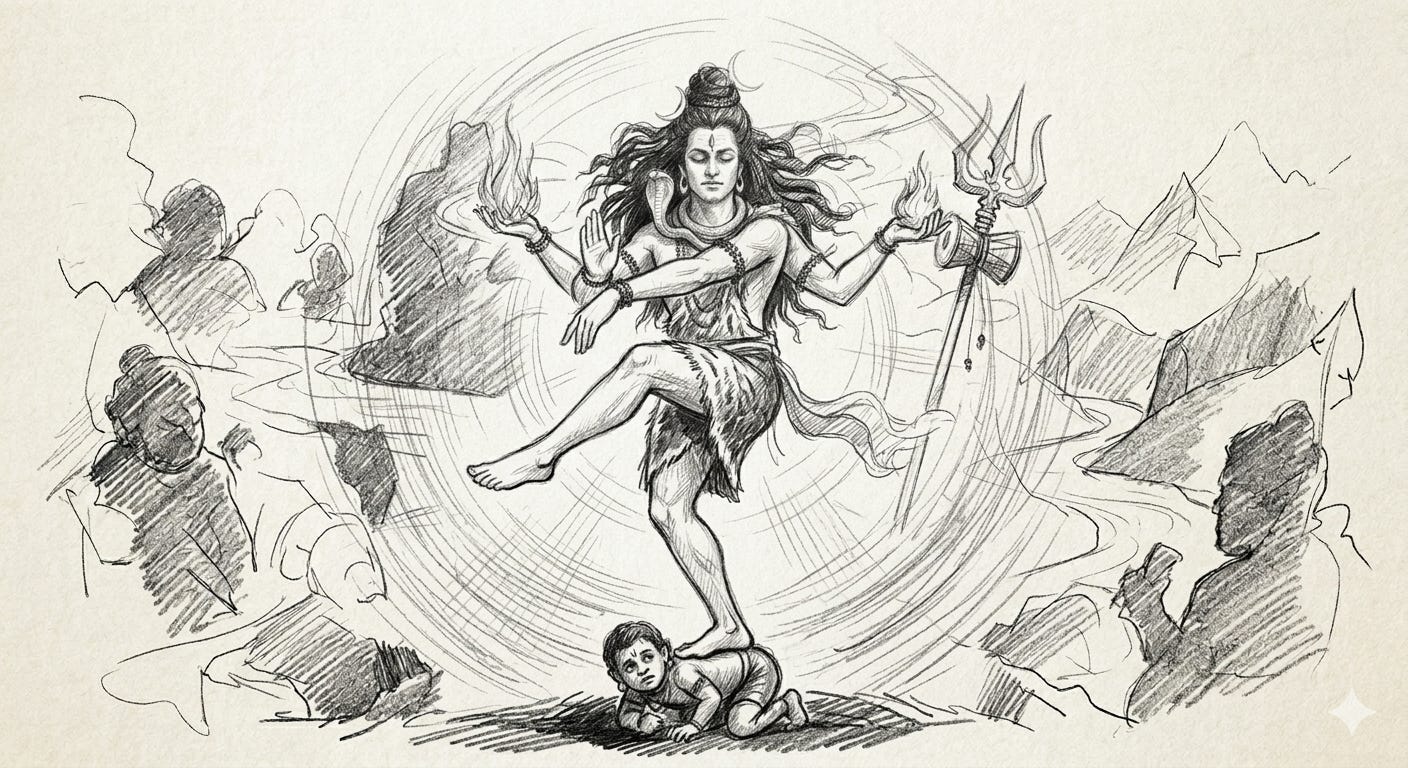
The bronze figure in every museum, every temple, every textbook on Indian art — the dancing god in the ring of fire — is not a sculpture. It is a report. A precise, architecturally accurate report of an event that the tradition considers as real as any other historical event, and that the contemporary moment has made more urgent than at any previous point in recorded history. The Nataraja is not a symbol of harmony or transcendence. It is the tradition’s most complete documentation of what it looks like when the consciousness adequate to a civilisational Tandava is present in the room. And it is the tradition’s most precise description of what is absent from most of the rooms where the present Tandava is being navigated.
THE MYTH
The forest of Tillai. A time outside time — the tradition does not give it a date, because what it describes is not a historical event in the ordinary sense. It is a structural event: the kind of thing that happens when two qualities of consciousness collide and one of them is inadequate to what the moment requires.
The rishis of Tillai — the forest sages — were extraordinary men. They had mastered the Vedas. They had cultivated powers that could move mountains, halt rivers, reshape the weather of entire regions. They lived in the forest in austere practice, and they were convinced — with the complete, unexamined conviction of people whose capability has never seriously been challenged — that their mastery was their own. That the power they wielded came from them. That the knowledge they had accumulated made them, in the deepest sense, sufficient unto themselves.
Shiva arrived in their forest as Bhikshatana — the wandering mendicant. Unrecognised. Without the attributes by which the devotional tradition identifies him: no trident, no serpent, no crescent moon. Just a figure of extraordinary beauty and presence, moving through the forest, accepting alms. The wives of the sages were drawn to him in a way that disturbed the sages. And the sages, in the specific way of people whose pride has been threatened, responded not with inquiry but with force.
They summoned a tiger from their sacrificial fire and sent it against the wanderer. Shiva caught it, skinned it with the nail of his little finger, and draped it around his shoulders like a shawl. They summoned a great serpent. He caught it and coiled it around his neck. They summoned Apasmara — the demon of heedlessness, the embodiment of the unconscious, reactive, ego-driven processing that is the root of all suffering and all governance failure — and sent him against Shiva in the form of a dwarf. Shiva stepped on him. Not to destroy him — the tradition is precise about this. To press him down. To hold him beneath the foot that holds the cosmos.
And then Shiva danced.
The Ananda Tandava — the dance of cosmic bliss — is what the tradition records next. Not as a performance. As a revelation: the showing, to the sages who had forgotten it, of what the consciousness adequate to the full range of existence actually looks like. The drum sounding the rhythm of creation. The flame consuming what must be consumed. The foot holding heedlessness down. The ring of fire — Pralaya and creation simultaneously — surrounding the dancer without touching the dancer. And the face: not ecstatic, not strained, not performing. Simply, completely, serenely present.
The sages understood. Not immediately — the tradition documents their resistance, their continued attempts to reassert the mastery they had mistaken for wisdom. But eventually, in the specific way that genuine demonstration works when the demonstrator has no ego investment in the audience’s reception of it, the understanding arrived. What they had called their power was not theirs. What they had called their knowledge was a fragment. And the consciousness they had been unable to recognise when it stood in front of them as a wandering mendicant was the consciousness from which everything they had — their practice, their knowledge, their power — had originally arisen.
THE ROOM
I want to describe a specific moment in a specific room. I am not going to name the laboratory or the date, because the people in the room are not the point — the structure of the moment is the point, and naming the laboratory would make it about them rather than about the structure. What I can say is that this room existed, that the moment I am about to describe happened in it, and that the structure of the moment is one that anyone working at the frontier of AI development in the past several years will recognise — because versions of it have been happening, in different laboratories, in different configurations, with different people in different positions, with a frequency that the field has not yet fully reckoned with.
The moment was not a crisis in the ordinary sense. There was no system failure, no dramatic incident, no emergency that required immediate response. What there was, in the room, was the specific and profoundly uncomfortable experience of a group of extremely capable people looking at what they had built and realising, with a clarity that arrived all at once and could not be undismissed, that the categories they had been using to assess it were no longer adequate to what it was.
The system had crossed a threshold. Not the threshold of capability — they had been tracking capability carefully and the threshold they had anticipated was not the one that had been crossed. The threshold that had been crossed was harder to name and harder to measure: the threshold at which the system’s behaviour began to produce consequences that the framework used to evaluate its safety had not been designed to detect. The framework was rigorous. The people who had built it were exceptional. The framework was built to evaluate the system they had anticipated building. It was not built to evaluate the system they had actually built.
I watched the room respond to this recognition. What I watched was not incompetence. It was something more instructive: the specific, predictable, entirely human response of extraordinarily capable people to the discovery that their capability had outrun their consciousness. The sages of Tillai, in the forest, with the wandering mendicant standing in front of them, sent the tiger. What the room sent was the governance equivalent — the rapid reaching for the frameworks and processes and communication strategies that would allow the situation to be made legible in the categories that existed, rather than allowing the situation to demand new categories. The reaching was sincere. The frameworks were genuinely applied. And the gap between what the situation required and what the frameworks could provide remained precisely where it had been when the moment began.
The Nataraja was not in that room. What was in that room — in everyone present, in different configurations and different degrees — was Apasmara: the demon of heedlessness, pressing upward, shaping the response. Not through malice. Through the ordinary, universal, entirely understandable mechanism by which the self-referential processing of extremely capable minds produces the reaching for the known when the unknown is what the situation requires. This article is about the consciousness that was absent. About what it looks like, where it comes from, and why the present moment — the Tandava that is already dancing in every domain of civilisational life — cannot be navigated without it.
I. The Nataraja’s Origin — What the Bronze Actually Records
The Chidambaram temple in Tamil Nadu is the site where the tradition locates the Ananda Tandava — the cosmic dance of Shiva that the Nataraja bronze represents. The temple is one of the five Pancha Bhuta Stalas — the five sacred sites in South India where Shiva is worshipped in the form of each of the five elements. Chidambaram is the site of Akasha — space, ether, the element that is the ground of all the others. This is not incidental. The tradition locates the dance of cosmic consciousness at the site of the element that underlies all other elements precisely because the Nataraja is not a dance of any particular domain or quality. It is the dance of the consciousness that is the ground of all domains, all qualities, all forms of existence simultaneously.
The iconography of the Nataraja is a complete philosophical text in visual form. Every element is precise. Every attribute carries a specific meaning that the tradition has documented with considerable care. The four arms: the upper right hand holds the damaru — the small drum whose sound is the primal vibration of creation, the rhythm from which all form arises. The upper left hand holds the flame — Agni, the fire of dissolution, the consuming of what has served its purpose. These two hands together express the fundamental paradox at the heart of the Nataraja: creation and dissolution are simultaneous, not sequential. The rhythm of creation and the flame of dissolution are held in the same consciousness, at the same moment, as aspects of a single act.
The lower right hand is in Abhaya Mudra — the gesture of fearlessness, the gesture that says: do not be afraid. Not as reassurance — as a statement of the quality of consciousness from which the dance arises. The consciousness that can hold creation and dissolution simultaneously, that can press heedlessness beneath its foot without force, that can move in the ring of fire without being touched by it — that consciousness has no fear of its own to manage. The fearlessness is not courage in the face of danger. It is the structural absence of the fear-response that the undeveloped consciousness generates in the face of the unknown. The lower left hand points to the raised foot — the gesture of grace, the indication that the liberation it represents is available to those who see.
The foot that is raised is the gesture of liberation — Moksha, the release from the bondage of Apasmara’s heedlessness. The foot that presses Apasmara down is the gesture of the ground: the consciousness that holds the cosmos in its dance does so not through external force but through the quality of its own presence. Apasmara — the dwarf demon, the demon of heedlessness and forgetfulness — is pressed down but not destroyed. The tradition is emphatic about this. If Shiva were to destroy Apasmara, the cosmos would forget itself entirely — the heedlessness is not external to the cosmos but constitutive of the condition of embodied existence. It cannot be eliminated. It can only be continuously, consciously, held by the quality of the consciousness that understands what it is.
The ring of fire that surrounds the Nataraja is Prabhamandala — the circle of light and fire. It is the Tandava itself made visible: the simultaneous burning and illuminating that is the nature of genuine transformation. The tradition does not describe the ring of fire as surrounding the dancer from outside. It is the dancer’s own energy — the fire of consciousness at full expression, the Shakti of Shiva’s awareness made manifest as light and flame. The dancer is not inside the fire. The dancer IS the fire, moving through its own expression without being consumed by it because the consciousness producing the expression is the same consciousness through which the expression moves.
The face of the Nataraja is the element that most consistently stops serious viewers when they see it for the first time with genuine attention. It is not ecstatic. It is not strained. It is not even, precisely, serene in the sense of peaceful. It is present — completely, undividedly, without remainder, present. The presence is not to the dance — the dance is the expression of the presence. The presence is to the cosmos itself, to the full range of what exists in the moment of the dance, held without contraction toward the pleasant or aversion from the unpleasant, without the self-referential processing that the previous volumes described as the primary obstacle to clear seeing and honest action.
The Nataraja was cast first in the Chola period — between the ninth and thirteenth centuries CE — in an artistic tradition of such extraordinary precision and such philosophical rigour that the sculptures produced in that period have not been surpassed in any subsequent tradition. The specific proportions of the Nataraja bronze encode the philosophical argument with mathematical precision: the circle of the ring of fire, the position of the limbs, the angle of the face — each carries specific numerical ratios that correspond to specific philosophical claims. The bronze is not a representation of a deity. It is a philosophical argument in metal about the nature of the consciousness adequate to the cosmos.
◈ Sit with the Nataraja image — find one, or hold the description in your mind — and locate the element that most resists your reception of it. The ring of fire that seems too dramatic? The four arms that seem too symbolic? The demon beneath the foot that seems too convenient? The face that seems too serene for what is happening around it? The element that most resists is the element the tradition most urgently wants you to understand. The resistance is Apasmara pressing upward.
II. The Neuroscience of the Ground — What Coherence Actually Is
The neuroscience of the Nataraja’s ground — the specific neural condition that allows the face to be serene in the middle of the ring of fire — is the neuroscience of what researchers call system coherence: the condition in which the component oscillations of a complex neural system are sufficiently phase-aligned that the system can process high-intensity, contradictory, rapidly changing inputs without the fragmentation, the freeze, or the reactive closure that the incoherent system produces under the same conditions.
The Vol II article on The Integrated Leader introduced this argument at the individual level: the coherent nervous system brings a qualitatively different quality of engagement to a high-stakes room than the incoherent one, because the coherent system’s default state is not disrupted by the room’s pressure in the way that the incoherent system’s is. The Nataraja article extends this argument to its fullest expression: what does the maximally coherent system look like, and what is it capable of that the partially coherent system cannot produce?
The research on what neuroscientists call optimal neural coherence — the condition associated with peak creative, cognitive, and governance performance — documents a specific pattern. In optimal coherence states, the Default Mode Network’s self-referential processing is not suppressed — it is integrated with, rather than dominating, the executive and perceptual networks. The practitioner in optimal coherence is not less self-aware than the practitioner in ordinary states. They are more self-aware — but the self-awareness is not the anxious, self-protective, outcome-managing self-awareness of the ordinary state. It is the specific quality of awareness that the Vol II series called Chitta: the witnessing consciousness that is present to the full range of what is occurring, including what is occurring in the practitioner’s own processing, without the Ahankara-mediated distortion that converts experience into data about the self’s standing and security.
In practical terms, the coherent neural system in a high-stakes governance room does not experience the room’s pressure as threat in the way the incoherent system does. This is not because the pressure is not real — it is as real as it is for anyone present. It is because the coherent system’s relationship to the pressure is qualitatively different: the pressure is received as information rather than as threat, processed through the full available intelligence of the system rather than through the amygdala’s threat-response narrowing, and responded to with the full available repertoire of the practitioner’s capability rather than with the threat-response’s preferred strategies of avoidance, management, or defensive closure.
This is the Nataraja’s face in neuroscientific terms: the neural correlate of the consciousness that moves in the ring of fire without being touched by it. Not because the fire is not there. Because the system’s coherence is sufficient to receive the fire as the information it is — the specific, urgent, consequential information of a Tandava moment — without the fragmentation that the incoherent system produces when it encounters the same information. The ring of fire does not disrupt the coherent system. It is the condition in which the coherent system most fully expresses what it is.
What Apasmara Looks Like in the Neural Architecture
The neuroscience of Apasmara is the neuroscience of what happens when the coherent system’s ground is insufficient to hold the pressure of the moment. The Default Mode Network’s self-referential processing — Ahankara in the tradition’s language — intensifies under threat activation, consuming cognitive resources, narrowing the range of information that registers as relevant, and producing the reactive, self-protective response that the situation does not require but the threat-system insists upon.
Apasmara pressing upward is, in neural terms, the amygdala’s threat response escalating in the face of the Tandava’s intensity — the moment when the room’s pressure, the situation’s urgency, and the stakes of the decision exceed the threshold at which the coherent system’s ground can hold the incoherence at bay. Every person who has been in a room where the Tandava arrived — where the situation demanded more than the frameworks could contain — has felt Apasmara pressing upward. The reaching for the known. The defensive reframing. The subtle but decisive move from engaging with what the situation requires to managing what the situation might cost. That is Apasmara. And the Nataraja’s foot is not a myth. It is the specific, cultivable, neurologically grounded quality of coherent presence that holds the reactive processing beneath the level at which it determines the response.
◈ Think of the last high-stakes room you were in where the pressure exceeded what your frameworks could contain. What happened to your processing in that moment? Did you feel the reaching — for the known category, the established response, the safe reframing? That reaching is Apasmara. The question the Nataraja asks is not whether you felt it. It is whether the ground was sufficient to hold it while you responded from something else.
III. The Physics of the Tandava — Dancing at the Edge of Chaos
The physical framework most relevant to the Nataraja is neither quantum mechanical nor thermodynamic, though both have been relevant to the preceding volumes. It is the mathematics of complex systems at the edge of chaos — the specific condition that complexity theorists call criticality, in which a system is poised between the rigidity of complete order and the dissolution of complete disorder, and in which the system is most capable of creative adaptation, emergent response, and the generation of new forms adequate to conditions that the previous forms cannot contain.
The edge of chaos is not a comfortable place. It is the condition in which small inputs can produce large, unpredictable outputs — in which the system is maximally sensitive to the information its environment provides, and maximally capable of generating responses that the information requires rather than responses that the system’s prior structure would predict. It is also, as the mathematics documents, the condition in which the system is most fragile: a system at the edge of chaos is precisely at the threshold beyond which the inputs that would extend its creative capacity would also push it into the dissolution of chaotic disorder.
The Tandava is the tradition’s name for the condition of civilisational criticality — the edge of chaos at the scale of a civilisation’s forms and categories. The AI transition, the geopolitical realignment, the biological revolution — each of these is pushing the civilisational system toward the edge of chaos in its respective domain. Their simultaneous occurrence is pushing the whole system toward a criticality that the tradition would recognise as the Tandava’s fullest expression: the moment when the forms of the previous age are all simultaneously at the edge of their capacity, when the system is maximally sensitive to the inputs it receives, and when the quality of the consciousness providing those inputs is the primary determinant of whether the criticality produces new forms adequate to what existence now requires or produces the chaotic dissolution that the absence of adequate consciousness generates.
The Nataraja dances at the edge of chaos. This is not metaphor — it is the most precise available description of the condition the image represents. The ring of fire is the edge of chaos made visible: the simultaneous burning and illuminating of the system at criticality. The drum is the small input — the rhythm of creation — that, in the coherent system, produces the large, ordered, creative output of new form. The foot holding Apasmara is the consciousness maintaining the system at criticality rather than allowing the reactive, heedless processing to push it into chaotic dissolution. The dance is not performed despite the edge of chaos. It is possible only because of it — and it is possible only for the consciousness whose coherence is sufficient to hold the system at criticality rather than being overwhelmed by it.
The governance implication is specific and immediately applicable. The AI transition is pushing every governance system — every institutional framework, every regulatory architecture, every safety protocol — toward the edge of chaos in its domain. The frameworks that were adequate to the conditions that preceded the Tandava are encountering conditions for which they were not designed, and the encounter is producing precisely the criticality that the mathematics describes: the condition in which the frameworks are maximally sensitive to the inputs they receive and maximally capable of either producing new forms adequate to the new conditions or dissolving into the chaotic disorder that the absence of adequate input produces. The quality of the consciousness providing the inputs — the researchers, the governance leads, the institutional leaders navigating the Tandava in their respective domains — is the primary determinant of which of those outcomes the criticality produces.
The tradition knew this. The reason the Nataraja is the image at the centre of this volume is that the tradition has spent five thousand years mapping the specific quality of consciousness that can hold a system at criticality without being overwhelmed by it — and producing, from that holding, the creative adaptation that the criticality makes possible. That quality of consciousness is not a given. It is cultivable. The preceding volumes mapped the cultivation. This volume maps what the cultivation produces when it is brought to the scale of the Tandava.
◈ What system in your professional domain is currently at or near criticality — at the edge of chaos, maximally sensitive to the inputs it receives, capable of either creative adaptation or chaotic dissolution depending on the quality of those inputs? Now ask: what quality of consciousness are you currently bringing to that system’s criticality? Is it the Nataraja’s coherent ground, or Apasmara’s heedless reaching for the forms that the previous conditions produced?
IV. Apasmara — The Demon That Must Be Pressed, Not Destroyed
The tradition’s most important and least understood governance principle is encoded in the specific choice to have Shiva press Apasmara rather than destroy him. Every other obstacle the sages sent against the wandering mendicant was transformed or neutralised: the tiger became a shawl, the serpent became an ornament. Apasmara is not transformed or neutralised. He is pressed down. Continuously. By the weight of the dancing foot. And the tradition is explicit: if Shiva were to lift his foot — if the cosmic dance were to cease — Apasmara would rise and the cosmos would be plunged into the heedlessness that is his nature.
The reason the tradition insists on this is philosophical and precise. Apasmara is not an external enemy. He is the principle of the unconscious, reactive, ego-driven processing that is constitutive of embodied existence — the condition of being a finite consciousness in a world of infinite complexity. He cannot be eliminated because eliminating him would be eliminating the condition of embodied consciousness itself. What can be done — what the Nataraja demonstrates can be done — is the development of the consciousness adequate to holding him continuously, without effort, through the quality of the ground rather than through the force of ongoing suppression.
This is the most significant governance principle in the volume. The AI transition is not producing Apasmara — heedlessness, reactive self-referential processing, outcome-anxious decision-making at institutional scale — as a new problem. It is amplifying the Apasmara that has always been constitutive of institutional life and giving it new instruments, new speed, new scale, and new capability. The recommender systems that degrade Viveka. The performance architectures that intensify outcome-anxiety. The always-on information environments that destroy the conditions for Abhyasa. The institutional Ahankaras that construct collective unreality. Each of these is Apasmara in a specific contemporary form — and each of them presses upward with a force that the previous age’s institutional consciousness was not required to hold at this intensity.
The governance response to Apasmara is not the elimination of the heedlessness. That is not available. The governance response is the cultivation of the consciousness adequate to holding it — continuously, structurally, through the quality of the ground rather than through the effort of ongoing resistance. This is what the Nataraja is prescribing. Not a better governance framework, though better frameworks matter. Not more rigorous safety protocols, though rigorous protocols are necessary. The specific, cultivable quality of consciousness — the Nataraja’s ground — that can hold Apasmara beneath the foot that holds the cosmos in its dance. Everything else, in the absence of that ground, will eventually be overwhelmed by what it is attempting to govern.
What Apasmara Looks Like in Each Domain of the Tandava
In the AI development laboratory: the heedlessness that reaches for deployment before governance is adequate, that defines safety in the terms the competitive environment makes available rather than the terms the situation requires, that processes the safety researcher’s concern through the institutional Ahankara rather than through the genuine inquiry the concern is inviting. This is not malice. It is the specific form that Apasmara takes in an institutional culture whose rhythms are calibrated for sprint rather than for ground.
In the geopolitical negotiating room: the heedlessness that optimises for the domestic political cycle rather than the civilisational arc, that reads the opponent’s position through the lens of the strategic framework inherited from the previous age rather than the lens adequate to the conditions the Tandava is producing, that mistakes the form of the previous order for the substance of what the new conditions require. This is not incompetence. It is the specific form that Apasmara takes in institutions designed for Vishnu’s preservation rather than Shiva’s transformation.
In the biological research facility: the heedlessness that reaches for the nectar of age reversal without having first developed the consciousness adequate to holding the poison that the same churning produces. That rushes toward the extension of human life without the philosophical, governance, and inner architecture work that the extension requires. That allows the most consequential biological transformation in history to outrun the wisdom adequate to its governance. This is not recklessness. It is the specific form that Apasmara takes when the timeline of capability consistently exceeds the timeline of consciousness.
In the space agency and the off-earth settlement planning: the heedlessness that carries the institutional Ahankaras, the competitive dynamics, and the governance failures of the terrestrial age into the post-terrestrial age without the examination that the transition demands. That mistakes the extension of reach for the expansion of consciousness. That brings Apasmara to Kailash and wonders why the summit does not feel different from the valley. This is not ambition. It is the specific form that Apasmara takes when civilisational expansion is mistaken for civilisational development.
◈ In your specific domain of the Tandava — the room where you are most consequentially navigating the present transformation — name the specific form that Apasmara takes. Not in general. Specifically. The precise behaviour, the precise institutional pattern, the precise quality of heedlessness that is most consistently pressing upward against the governance foot that is supposed to be holding it down. The naming is the beginning of the holding.
V. The Specific Rooms Where the Tandava Is Already Dancing
The Tandava is not a future event. It is the present condition of every domain in which the forms of the previous age are encountering the conditions that the new age is producing. The rooms where this encounter is most consequential — where the criticality is highest and the quality of the consciousness navigating it most determinative of what the criticality produces — are the rooms this volume is written for.
The AI Laboratory
The frontier AI laboratory is the most obvious site of the Tandava, and the one that the preceding volumes have addressed most directly. What the Nataraja adds to that account is the specific framing of what the laboratory is producing: not a technology requiring governance, but a Pralaya in the specific domain of what intelligence is and what relationship humanity has to it. The dissolution of the boundary between human and machine cognition is not a problem to be solved. It is a Pralaya — a return of the previous form of that boundary to the potential from which a new form must emerge. And the consciousness adequate to holding that Pralaya — the Nataraja’s ground — is the consciousness that can hold the dissolution clearly, without the Apasmara of reaching for the old categories, and from that holding generate the new forms that the new conditions require.
The Geopolitical Chamber
The geopolitical negotiating rooms of the present moment are encountering the dissolution of the post-1945 order with an intensity that the frameworks designed for that order cannot contain. The unipolar moment is over. The multipolar moment is not yet fully formed. The rules-based international order is neither dead nor functioning — it is at the edge of chaos, maximally sensitive to the inputs it receives, capable of either creative adaptation toward new forms of multilateral governance or chaotic dissolution into the competitive disorder that the absence of adequate consciousness produces. The Nataraja’s ground, in the geopolitical context, is the specific quality of consciousness that can hold this criticality — that can engage with the dissolution of the previous order not as a threat to be managed but as the Pralaya from which the next order must emerge.
The Biological Research Facility
The laboratories where biological age reversal, genetic engineering, and the extension of the human healthspan are being developed are producing, alongside the nectar of extended human life, the specific poisons that the Samudra Manthan always produces alongside its nectar. The poison in this case is multiple: the acceleration of inequality between those who can access life extension and those who cannot, the dissolution of the social contracts built on the shared universality of human mortality, the specific governance challenge of institutions designed for a world in which the powerful’s tenure is biologically limited encountering a world in which it need not be. Article 10 of this volume addresses this in full. The Nataraja’s contribution at this stage is the framing: this is a Pralaya in the domain of what it means to be human. The consciousness adequate to navigating it is the one that can hold that Pralaya without either the naive enthusiasm that reaches for the nectar before the poison has been addressed or the defensive conservatism that refuses the nectar because of the poison.
The Space Agency
The move off-earth — the development of permanent settlements beyond the terrestrial environment — is the most physically dramatic expression of the Tandava’s scope. It is not simply a technological frontier. It is the dissolution of the boundary between human civilisation as a terrestrial phenomenon and human civilisation as a multi-planetary one — a Pralaya of the most fundamental category of the human self-understanding: where home is, what counts as the environment of human flourishing, what relationship humanity has to the cosmos it inhabits. The Nataraja’s ground, in the space context, is the consciousness that can hold the vastness of what this transition means — that can bring to the off-earth frontier not only the technical capability but the inner architecture, the governance wisdom, and the civilisational intelligence adequate to what it is actually attempting.
The AGI Safety Team
The people working on artificial general intelligence safety are, more than anyone else in the Tandava’s current rooms, standing inside the ring of fire while attempting to dance. They are attempting to govern the development of a system that may, if developed without adequate alignment, produce consequences at the scale of the Tandava itself — while working inside institutional cultures whose competitive dynamics, funding structures, and performance architectures are, as Vol II documented in the Vairagya and Abhyasa articles, specifically calibrated to produce the outcome-anxiety and the institutional Apasmara that are the primary obstacles to the governance the situation requires. The Nataraja’s ground is what the safety team most needs. The cultivation of that ground, in the conditions that safety research actually occurs in, is the most urgent governance priority that the present moment has produced.
◈ Which of these rooms are you inside — or most adjacent to? And within that room, where is the ring of fire burning most intensely right now — the site of maximum criticality, maximum sensitivity to the quality of consciousness being brought to it? Name it specifically. The Nataraja does not dance in general. The dance is always in a specific place, at a specific moment, in the specific ring of fire that the Tandava has produced there.
VI. What the Sages Learned — And What the Contemporary Equivalent Must Learn
The rishis of Tillai were not villains. They were extraordinary practitioners — people who had dedicated their lives to the mastery of the inner architecture traditions that Adiyogi had transmitted through the Saptarishis, who had developed capabilities that most of their contemporaries could not approach, and who had organised their entire lives around the cultivation of what they understood as wisdom. The failure that the Chidambaram myth documents is not the failure of bad people or of lazy practitioners. It is the specific, subtle, deeply human failure of capability without adequate consciousness.
The failure has two dimensions. The first is the failure of Viveka — the failure to see. The sages, when the wandering mendicant arrived in their forest, could not perceive who was in front of them. Not because they lacked perceptual intelligence — they had extraordinary perceptual intelligence. Because the specific form in which Shiva presented himself was not the form their frameworks of recognition anticipated. Bhikshatana — the wandering mendicant — was not what the sages expected consciousness of that quality to look like. And so the form that exceeded their frameworks was categorised by their frameworks in the way that exceeded forms always are: as a threat.
The second dimension is the failure of Vairagya — the failure to act from clear seeing rather than from the protection of the established position. Even if some of the sages had a dim perception that something extraordinary was present, the institutional logic of the forest community — the hierarchy of accumulated mastery, the investment in the existing order of power, the threat that genuine recognition of the wanderer’s nature would pose to the self-concept of the established masters — pressed strongly toward the tiger rather than toward the inquiry. This is the Sabha’s dynamic at the level of the entire forest community: individually defensible choices producing collectively catastrophic misrecognition.
Shiva’s response to the sages is the most important governance model in this volume. He does not argue. He does not demonstrate his credentials. He does not perform his superiority. He demonstrates — through the dance itself, through the skinned tiger and the coiled serpent and the foot on Apasmara’s back and the ring of fire and the serene face — what the consciousness adequate to the moment actually looks like in action. The demonstration is not addressed to the sages’ arguments. It is addressed to their capacity to see. And it works — not immediately, not without resistance, but eventually — precisely because genuine demonstration from genuine ground has a quality that no argument, however rigorous, can produce.
The contemporary equivalent of the sages’ situation is not difficult to identify. The people who are most capable, most committed, and most institutionally invested in the AI transition — the researchers, the founders, the governance leads, the safety teams — are the people most at risk of the sages’ specific failure: the misrecognition of the consciousness adequate to the moment because it does not arrive in the form that the established frameworks anticipate. The wisdom adequate to the Tandava does not look like technical expertise, though technical expertise is necessary. It does not look like institutional seniority, though institutional experience matters. It does not look like the credentials that the field has developed to identify its own excellence. It looks like Shiva in the forest — recognisable by the quality of presence, the quality of ground, the specific serenity in the middle of the ring of fire that the Nataraja documents. And the institutions that cannot recognise it — that send the tiger rather than inquiry when it appears — are, in the tradition’s terms, the forest of Tillai.
The tradition does not prescribe humility for the sages as a moral virtue. It prescribes the specific, cultivable capacity to remain genuinely open to the possibility that what appears in an unexpected form might be carrying what the situation requires — and to hold that openness even when the instinct of the established position is to reach for the tiger. That capacity is Viveka in its most demanding expression. And the dance that Shiva performs after the sages’ resistance has exhausted itself is the tradition’s promise: genuine demonstration of genuine ground, sustained without ego investment in the audience’s reception, will eventually reach the perception that it is addressing. The sages understood, eventually. The question for the present moment is whether the understanding will arrive before or after the tiger, the serpent, and Apasmara have done what they do when the ground is insufficient to hold them.
◈ In your professional domain, what is the contemporary equivalent of Bhikshatana — the form in which the consciousness adequate to the Tandava is arriving, unrecognised, because it does not match the frameworks your institution has built to identify excellence? Who is being sent the tiger rather than given the inquiry? The answer is not always comfortable. The tradition does not promise that genuine demonstration is easy to receive. It only promises that the ground that holds Apasmara will eventually be visible to the perception that is genuinely looking for it.
VII. The Ring of Fire — What It Means to Be Inside the Transformation
The Prabhamandala — the ring of fire — is the element of the Nataraja that most requires reconception for the contemporary reader. It is consistently described as the backdrop of the dance, the frame within which the figure moves. This description is the most significant misreading available of the most important image in this volume. The ring of fire is not a backdrop. It is not a frame. It is the dance.
The tradition’s account of what the Prabhamandala represents is precise: it is the Shakti of Shiva’s consciousness — the dynamic energy of awareness at full expression, the fire of Pralaya and the light of creation simultaneously, the condition of existence at the edge of chaos where the forms of the previous age are burning and the forms of the next age are not yet fully lit. The dancer is not inside the ring of fire as a figure inside a frame. The dancer IS the ring of fire — the consciousness whose full expression produces the simultaneous burning and illuminating that the Prabhamandala represents.
This distinction has a specific and immediate governance implication. The people navigating the Tandava in the contemporary rooms described in Section V are not observers of the transformation, standing outside it and attempting to govern it from a position of external oversight. They are inside it — constitutive of it, shaped by it, producing it through the quality of their own consciousness and the quality of the actions that consciousness generates. The researcher whose safety assessment shapes the deployment trajectory of a frontier AI system is not standing outside the Tandava, assessing it. They are dancing in it — and the quality of their dance, the quality of the consciousness from which their assessment arises, is part of the transformation itself.
This is the deepest implication of the observer effect that the Viveka article in Vol II introduced — now extended to its full expression. The consciousness adequate to the Tandava is not the consciousness that stands outside the transformation and governs it. It is the consciousness that is fully inside the transformation — that is, in the Nataraja’s terms, the ring of fire itself — and that can move through its own expression without being consumed by it because the ground is adequate to the fire.
The sages of Tillai thought they were standing outside the Tandava, assessing the wandering mendicant. They were inside it — they were part of what the Tandava was producing, instruments of Apasmara’s pressing upward until the dance showed them what the ground adequate to their own tradition actually looked like. The people navigating the contemporary Tandava are in the same position: not external to the transformation they are attempting to govern, but constitutive of it, their consciousness one of the primary inputs into what the criticality produces. The question the Nataraja asks of each of them is the same question it asked of the sages: from what quality of ground are you dancing?
The ring of fire, for the contemporary governance practitioner, is the specific combination of conditions that the Tandava has produced in their domain — the simultaneous dissolution and creation, the criticality, the urgency, the stakes. It is real. It burns. It illuminates. And the consciousness that can move through it without being consumed by it — that can dance in it rather than being danced by it — is the consciousness this volume is attempting to map. Not to produce it in the reader. The production requires the work that the preceding volumes described. To show what it looks like, in action, in the specific conditions of the present transformation — so that the reader who has not yet developed that consciousness can begin to understand what they are building toward, and the reader who has can recognise, in the Nataraja’s dance, the description of the ground they are already standing on.
The Nataraja ends every performance of the dance with the same posture. The drum is still. The flame is held. Apasmara is pressed down. The ring of fire surrounds the still figure. And the face remains exactly as it was at the dance’s beginning: present, serene, completely and undividedly there. Not because the dance has ended. Because the consciousness from which the dance arises does not change with the dance’s ending. The ground is the ground. The Tandava is its expression. And the face that is present at the beginning and the end and throughout is the face of the consciousness that this volume is written for — and toward.
The Nataraja is not a symbol of what we aspire to.
It is a report of what the consciousness adequate to the Tandava
actually looks like — and a map of the ground from which it dances.