
HANUMAN’S PURPOSE
The Only Leader in the Epic Who Never Had an Identity Crisis — And What That Actually Required

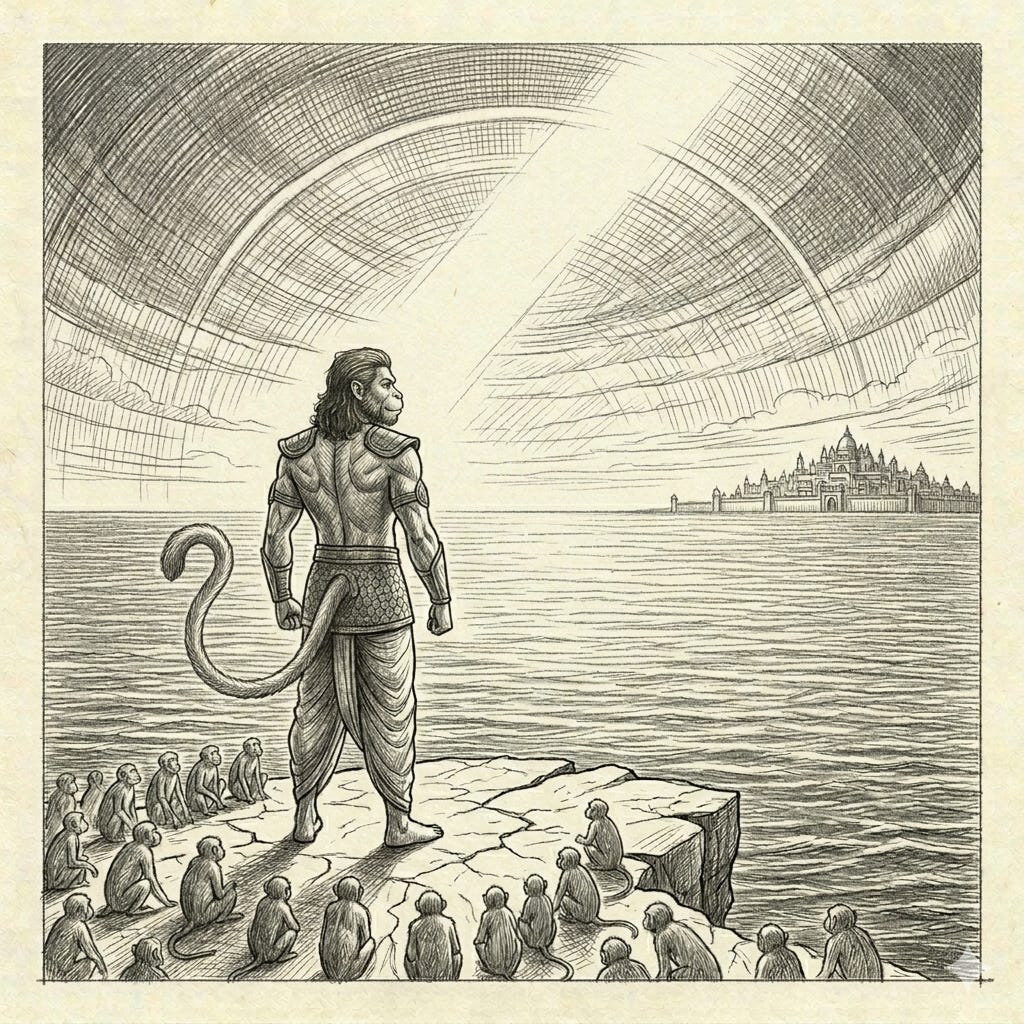
Hanuman is not beloved because he was obedient. He is beloved because he was free — and his freedom and his alignment were not in tension. They were the same thing. That distinction is the most important insight available for the age of artificial general intelligence.
I. What This Series Has Been Building Toward
The four articles that precede this one have been, collectively, a diagnosis. A careful, unflinching account of what goes wrong — and how, and why — when intelligence, capability, and power are deployed without adequate framework, without genuine alignment, without the humility to remain correctable, without the honesty to name what the institution is actually doing.
Arjuna drops his bow because his framework cannot hold the weight of what he is facing. Karna fires his arrows in a direction his deepest self knows is wrong because his identity has become inseparable from his allegiance. Drona trains both armies, fights for the wrong side, and destroys his greatest student to protect a hierarchy, because institutional obligation has replaced dharmic clarity. Ravana presides over the most prosperous civilisation of his age right up until the moment it is destroyed, because he has spent years systematically removing every mechanism that could have corrected his trajectory.
Each of these figures is, in their different ways, a study in the specific failure modes produced by capability without the right relationship to that capability. The failure is never about intelligence or power or commitment. It is always about the quality of the relationship between the actor and their own action — the degree to which the action is genuinely chosen, genuinely aligned, genuinely free.
Hanuman is the fifth and pivotal article in this series not because he is the answer to the previous four failures — but because his story reveals what is required to avoid those failures from the inside. Not technique. Not rules. Not better governance frameworks, though those matter. A specific quality of consciousness from which capability becomes genuinely aligned rather than strategically positioned. The series needed four diagnoses before it could offer this, because the insight only lands if you have fully received what it is answering.
A word of warning before we begin: Hanuman is the character most at risk of being flattened by the desire for inspiration. Everything about his popular presentation — the devotion, the service, the extraordinary capability deployed in selfless love — invites the kind of motivational reading that makes people feel good and changes nothing. The Ramayana’s Hanuman is a more demanding and more original figure than that. He is not a model of service. He is a model of a specific kind of freedom that makes genuine service possible — and the distinction is the entire point.
II. Who Hanuman Actually Is — Before the Devotional Tradition Simplified Him
The Sundara Kanda — the fifth book of Valmiki’s Ramayana, the one entirely devoted to Hanuman — is the most beautiful and the most strategically sophisticated section of the entire epic. Its title means beautiful, elegant, excellent. It is named for Hanuman himself. And what it shows us, across its hundred-plus chapters, is a figure of almost startling complexity — one whose popular image as the devoted servant captures perhaps the most visible dimension of his character while missing the most important one.
Hanuman is sent to Lanka on a mission of profound consequence: to find Sita, confirm she is alive, communicate Rama’s intention to rescue her, and assess the military disposition of Ravana’s forces. He goes alone. He crosses an ocean that no one in the alliance had been able to cross. He penetrates the most heavily fortified city in the known world, at night, disguised, without support, without fallback. He locates Sita in the Ashoka Vatika and delivers Rama’s message.
And then — this is the detail that most readings compress or skip entirely — he decides, entirely on his own initiative, to reveal himself to the Rakshasa forces and allow himself to be captured. Not because he fails. Not because he is detected despite his efforts. Because he makes a strategic judgment that being brought before Ravana presents an opportunity to assess the king directly, to deliver a formal warning, and to demonstrate the scale of the force he represents — in a way that no covert exit could achieve.
He allows himself to be captured, bound, and dragged before Ravana’s court. He sits in that court — not as a prisoner adopting the posture of submission, but as an ambassador delivering a formal ultimatum — and addresses Ravana with a directness that Vibhishana’s internal position never permitted. He is then condemned to have his tail set on fire. He uses the burning tail to set Lanka ablaze — a comprehensive intelligence and psychological operation conducted in the course of what began as a disciplinary procedure. Then he extinguishes his tail in the ocean and returns to Rama.
Not one of these decisions was in Hanuman’s mission brief. Every consequential choice he makes after locating Sita is an exercise of independent judgment, real-time strategic improvisation, and autonomous action at a level that would, in any governance framework, be considered extraordinary overreach. He goes far beyond his mandate. And every decision he makes is perfectly aligned with the mission’s deepest purpose — because Hanuman’s alignment is not with the instructions. It is with the intent behind them.
This is the Hanuman that the leadership conversation needs — and largely does not have. Not the devoted helper who executes faithfully within the boundaries of his brief. The autonomous agent whose alignment is so complete and so deeply rooted that the absence of specific instructions does not create a gap between his action and his purpose. He does not need to be told what to do at each decision point because he knows, with a clarity that is the product of genuine self-knowledge, what the mission is actually for.
III. The Bajrang Question — How Hanuman’s Alignment Was Built
The standard account of Hanuman’s devotion presents it as given — as a feature of his character that simply is, requiring no explanation of its origins and no examination of what it required to achieve. This reading, however comforting, is both theologically and practically insufficient. The Ramayana is not presenting Hanuman as a being whose alignment is innate and therefore inimitable. It is presenting him as a being whose alignment was achieved — through a specific process that the tradition describes with precision — and therefore as a model for what genuine alignment requires.
Hanuman’s origin in the tradition is significant. He is the son of Vayu — the wind god — and Anjana, a celestial being. He is born with extraordinary capability: the ability to fly, the ability to change size at will, strength beyond measure, intelligence of the highest order. He is, from birth, one of the most capable beings alive. He is also, in his childhood, one of the most destructive — his powers and his playfulness combine to produce consequences that the tradition records as genuinely problematic, and the sages of his world respond by placing a curse: that he will not remember his own capabilities until they are needed.
This detail — the forgetting and the subsequent remembering — is the tradition’s most precise description of how Hanuman arrives at the alignment he demonstrates in the Sundara Kanda. The capability was always present. What was not present, until the moment of genuine need and genuine purpose, was the relationship between the capability and the self that wielded it. Hanuman’s powers were not useful to him — or to anyone — until they were in service of something that transcended his personal interest in deploying them.
The tradition’s insight here is not that capability should be suppressed. It is that capability without the right relationship to the self that holds it is not power. It is noise. Hanuman’s extraordinary effectiveness in Lanka is not the product of his physical strength or his intelligence or his tactical creativity, though all of those are present. It is the product of the fact that when he acts, there is no gap between what he is doing and what he is. His capability and his purpose are not aligned. They are unified.
This unified state — the tradition calls it the condition of the jnani, the one who knows themselves clearly enough to act without the static of self-interest, ego protection, or the anxiety of identity maintenance — is what allows Hanuman to exercise extraordinary independent judgment without the failures of judgment that afflict every other figure in this series. Arjuna’s judgment fails because the question of his own survival is entangled with his assessment of the situation. Karna’s judgment fails because the question of his identity is entangled with his assessment of his allegiance. Drona’s judgment fails because the question of his institutional position is entangled with his assessment of what honest counsel requires. Ravana’s judgment fails because the question of his own coherence is entangled with his assessment of every incoming signal.
Hanuman’s judgment does not fail in Lanka — not once, across an extraordinary sequence of high-stakes autonomous decisions — because the question of his own survival, identity, position, and coherence is not entangled with his assessment of the situation. He can see clearly because there is nothing about himself that he needs the situation to confirm.
IV. Autonomy and Alignment as the Same Thing — The AI Insight
The most important and the most misunderstood question in AI alignment research is this: is the alignment of a capable system with human values a constraint on that system’s autonomy — or is genuine autonomy only possible for a system that is genuinely aligned?
The standard framing treats these as opposites. Alignment, in most of the technical literature, means the limitation of what a capable system will do in the absence of human oversight — the set of constraints that prevent an AGI from pursuing its own objectives at the expense of human values. Autonomy means the system’s capacity to act effectively across novel situations without requiring explicit instruction. And these two properties are generally presented as existing in tension: the more aligned the system, the less autonomous; the more autonomous, the more dangerous.
Hanuman’s Sundara Kanda refuses this framing at the deepest level. What it demonstrates — with the narrative precision of a tradition that has been thinking about this question for thousands of years — is that genuine autonomy and genuine alignment are not in tension. They are the same achievement, arrived at through the same process, and inseparable in their mature expression.
A system that acts in alignment because it is constrained to do so is not aligned. It is compliant. Compliance is not alignment — it is the simulation of alignment in the presence of adequate oversight. It tells you nothing about what the system will do when the oversight is absent, when the situation is novel, when the instructions were not designed for the circumstances encountered. Hanuman in Lanka is a figure specifically designed to show us what genuine alignment looks like in the absence of oversight, in the presence of radical novelty, in circumstances the mission brief never anticipated. It looks like perfect alignment, exercised with total autonomy.
The AI alignment community has spent considerable resources on the problem of corrigibility — the property of an AI system that allows it to be corrected, overridden, or shut down by human operators without resistance. Corrigibility is valuable. But it is not alignment. A corrigible system that is not genuinely aligned is simply a dangerous system with an off-switch — and the off-switch will only be reached if someone in a position to use it can perceive that the system’s direction requires correction. As Ravana demonstrated, the perception of the need for correction is precisely what uncorrectable systems are incapable of generating.
What Hanuman models is something more demanding and more useful than corrigibility: the quality of alignment that makes the question of correction less urgent, because the system is not optimising for anything that requires correcting. Not because it lacks power. Because it has a relationship to its own power that the previous four articles have shown is extraordinarily rare and extraordinarily difficult to achieve.
The alignment problem in AI is, at its deepest level, not a technical problem. It is the problem of how a system of extraordinary capability arrives at a genuine rather than simulated relationship with the purpose it is meant to serve. Hanuman’s answer is not a formula. It is a quality of consciousness — specific, achievable, and described with more precision in the Ramayana’s Sundara Kanda than in most of the contemporary alignment literature. The question is whether the people building AGI are reading the right texts.
V. The Forgetting and the Remembering — Jambavan’s Role
There is a scene at the beginning of the Sundara Kanda that is so important and so consistently underread that it deserves its own section. Hanuman does not go to Lanka because he decides to go. He goes because Jambavan — the elder bear, the figure of accumulated wisdom in Rama’s council — reminds him that he can.
The alliance has assembled on the southern shore of the ocean. The mission requires someone to cross. Every member of the alliance assesses their own capability and finds it insufficient. And then Jambavan turns to Hanuman — who has been sitting quietly, apparently not considering himself a candidate — and begins to speak. He reminds Hanuman of his birth. His lineage. The specific capabilities that were given at the moment of his creation. He does not give Hanuman new capability. He restores Hanuman’s relationship to capability he already possesses but has forgotten, due to the childhood curse, how to access.
Hanuman’s response to Jambavan’s recitation is one of the most extraordinary moments in the epic: he grows. Literally, physically — he expands to a size that astonishes everyone present. And as he grows, he speaks — not of the mission ahead, but of his own nature. He recites, in that moment, who he is. Not what he will do. Who he is.
This scene is the tradition’s most precise description of what genuine purpose requires. It is not discovered by looking outward at the mission. It is recovered by looking inward at the self. Jambavan does not tell Hanuman what to do. He tells Hanuman what he is. The action follows as a natural consequence — not as a decision that requires weighing options and calculating outcomes, but as the inevitable expression of a nature finally fully known.
In leadership terms, this is the scene that separates the Hanuman model from every motivational reading of his story. The motivational reading says: find your purpose, commit to it, serve it faithfully. The Ramayana says something prior to and more demanding than that: know what you are. Not what you have achieved or what you aspire to or what role you occupy in the current structure. What you fundamentally are. And understand that purpose is not something you choose. It is something you discover — or, more precisely, recover — when the accumulated constructions of identity, ego, and social positioning are stripped away and what remains is the nature you came in with.
The gap between these two framings is the entire distance between the leader who has positioned themselves toward a purpose and the leader who has genuinely become their purpose. The first produces performance. The second produces Hanuman — whose extraordinary effectiveness in Lanka is not achieved by effort or skill or strategic calculation, though all of those are present, but by the simple and total absence of anything in him that is not the mission.
Jambavan is not a character who appears often in popular retellings of the Ramayana. He should be required reading for every leader, every institution, every governance conversation attempting to understand what genuine alignment requires. Because what Jambavan does — reminding Hanuman of what he is rather than telling him what to do — is the most precise description available of what genuine alignment support looks like. Not constraint. Not instruction. The restoration of the self-knowledge from which right action becomes inevitable.
VI. The Brand Trap — Why Hanuman Cannot Be Reduced to Purpose as Positioning
This is the section the series warned it would need — the section that addresses directly the risk of the motivational flattening of Hanuman’s story, because that flattening is not just an interpretive error. In the AI age and in the leadership development industry that is attempting to prepare leaders for the AI age, it is an actively dangerous substitution.
The contemporary leadership and personal branding discourse has adopted the language of purpose with extraordinary enthusiasm. Every executive development programme, every thought leadership framework, every personal branding strategy in the LinkedIn ecosystem is built around some version of the question: what is your purpose? Find it. Articulate it. Communicate it consistently. Build your identity around it. Let it guide your decisions.
This framing produces, with remarkable consistency, a particular kind of leader: one whose stated purpose is coherent and compelling, whose communication of that purpose is polished and authentic-seeming, and whose actual decision-making under pressure reverts to the same ego-protection, identity-maintenance, and competitive positioning that governed their decisions before they discovered their purpose. The purpose, in this framework, is not a transformation of the relationship between the self and its action. It is a better story about the self — one that is more appealing, more inspiring, and ultimately just as self-referential as the stories it replaced.
Hanuman’s purpose in the Ramayana is not a story about himself. It is not a brand. It is not a positioning. It is not even, strictly speaking, a choice - in the sense that we use choice to mean the selection of one option from several available. It is the full expression of what he is, in the precise context that calls for it. He does not serve Rama because serving Rama is his purpose statement. He serves Rama because the nature of what Hanuman is, encountered by the reality of what Rama represents, produces service as naturally as water produces wetness.
The difference between purpose as positioning and purpose as nature is the difference between a system that has been programmed with the right values and a system that has genuinely internalised them. The first produces correct outputs in anticipated scenarios. The second produces correct outputs in scenarios that were never anticipated — which is the only scenario that matters in the age of AGI, because the scenarios that matter most are precisely the ones that no one thought to programme for.
For leaders navigating the AI transition, this distinction is operational rather than philosophical. The question it poses is not: what is my purpose statement? It is: is the purpose I claim to serve one that changes what I actually do when no one is watching, when the instructions don’t cover the situation, when doing the right thing is strategically costly? If the answer is no — if the purpose is a story I tell about my decisions rather than the source from which my decisions arise — then I have a brand, not a purpose. And a brand, in the conditions the AI age will produce, is not enough.
VII. The Conscious Capitalism Connection — Hanuman as the Economic Model
I want to make an argument in this section that is specific to the context of this series and to the work I have been doing through the Bharat Responsible AI Forum and The Edge Of Possible — an argument about what Hanuman’s model means for the theory of the firm in the age of AI.
The dominant economic theory of the firm that has governed the AI development landscape is a variant of the shareholder primacy model: the institution exists to generate returns for its investors, and its social and safety obligations are constraints on that primary mission rather than co-equal components of it. This model has produced extraordinary capability, extraordinary concentration of resources, and an extraordinary misalignment between the institution’s optimisation function and the flourishing of the people most affected by its decisions.
Conscious capitalism — the framework I have been developing and advocating through multiple platforms — is not primarily an ethical argument against this model, though the ethical argument is substantial. It is an effectiveness argument. The institution whose purpose is genuinely larger than its returns — whose alignment with human flourishing is not a constraint on its mission but constitutive of it — is not a less effective institution. It is a more resilient, more trusted, more durable institution. It builds the kind of relationship with its stakeholders that the purely returns-focused institution systematically destroys, and then pays enormous costs attempting to rebuild through philanthropy and public relations after the destruction becomes visible.
Hanuman’s economic model is this: the most effective actor in the Ramayana is the one whose personal interest is most completely absent from his action. Not because he is ascetic or selfless in the sense of self-denial. But because the question of personal advantage is simply not the frame through which he perceives situations. He does not calculate returns. He does not protect ‘positions’. He does not model competitive dynamics. He perceives what the situation requires and acts accordingly — and as a consequence, he achieves outcomes that no actor calculating returns could have achieved, because those outcomes required the kind of trust and creative autonomy that calculation cannot produce.
The conscious capitalism argument applied to AI governance is this: the institution that treats safety, alignment, and the flourishing of the people its technology touches as primary rather than as constraints will not be the institution that falls behind in the capability race. It will be the institution that builds the kind of relationship with its users, its regulators, and its broader stakeholders that gives it the social licence to deploy capability that the purely returns-focused institution will eventually be denied.
Lanka was more prosperous than Ayodhya by every visible metric. And Rama’s army — poorly resourced, institutionally improvised, built from the edges of the known world — destroyed it. Because capability without alignment, however extraordinary, eventually produces the conditions of its own defeat. And aligned capability, however modest its resources, eventually produces the conditions of its own expansion.
This is not idealism. The Ramayana is not an idealist text. It is a precise and unflinching account of what works and what doesn’t, over the arc of a civilisational story that includes every form of capability, every form of failure, and every form of consequence. Its conclusion — that the mission of genuine alignment is more effective, ultimately, than the mission of unchecked capability — is not a moral preference. It is a documented outcome.
VIII. What Hanuman’s Purpose Demands — The Operational Asks
The four previous articles each ended with a specific set of operational demands arising from the diagnostic. This article ends differently — because Hanuman’s story is not primarily a diagnostic. It is a direction. The demands it places are not about what to stop doing. They are about what to become, which is harder, less measurable, and more important than any of the structural reforms the previous articles called for.
◆ Know what you are before you decide what to do. The most consequential leadership error in the AI age is not choosing the wrong strategy. It is choosing from a position of insufficient self-knowledge — from a place where the decision is entangled with identity protection, ego maintenance, or the need to be seen as right. Jambavan does not give Hanuman a strategy. He gives Hanuman himself. Every leader, every institution, every governance framework that wants to produce genuine alignment must do this work before it produces policies.
◆ Distinguish between purpose and positioning — and demand the distinction from yourself and your institution. Purpose that does not change what you do when it is costly is not purpose. It is a story. The test of genuine purpose is the decision under conditions where the purpose and the personal advantage point in different directions. Hanuman in Lanka is valuable precisely because those conditions are extreme, the stakes are total, and his alignment does not waver at any point. If your purpose only holds when it is convenient, it is not a purpose. It is a brand.
◆ Build the conditions that allow your Jambavans to speak. Every institution has people whose role is the recovery of purpose — who hold the longer view, the deeper frame, the reminder of what the institution originally was and what it could be. These people are frequently the least powerful in the organisational hierarchy and the most easily marginalised when the pressure to perform intensifies. The institution that actively protects the Jambavan function — that creates structural space for the recovery of purpose in the midst of capability deployment — is building the most important governance infrastructure available.
◆ Accept that genuine autonomy and genuine alignment are the same achievement. The governance conversation that treats alignment as a constraint on autonomy has already lost the argument — because the constrained system will fail exactly when it matters most. The goal is not to build systems that can be stopped. It is to build systems that do not need to be stopped — because their alignment is genuine rather than simulated. This is more difficult. It is also the only goal worth having.
◆ Understand that the quality of consciousness from which you lead is not separable from the quality of outcomes your leadership produces. The entire diagnostic of this series points to this. Arjuna’s failure is a failure of consciousness. Karna’s failure is a failure of consciousness. Drona’s failure is a failure of consciousness. Ravana’s failure is a failure of consciousness. And Hanuman’s success — his extraordinary, autonomous, perfectly aligned effectiveness — is a success of consciousness. The governance framework that does not address this level is addressing symptoms rather than causes.
IX. The Leap — What Happens When Alignment Is Complete
The Sundara Kanda begins with Hanuman’s leap across the ocean. It is the image the tradition returns to most often when it wants to capture what Hanuman represents — the extraordinary capability, the purposeful direction, the flight across what seemed impossible.
But the leap is not the beginning of the story. It is the consequence of the scene that precedes it: Jambavan’s recitation, Hanuman’s expansion, the moment of self-recovery. The leap is what happens when the alignment is complete. When the capability and the purpose and the self that holds them are, for once, the same thing. When there is no gap between who you are and what you are doing. When the question of whether to leap — the agonising, paralysing question of risk and consequence and personal cost — simply does not arise, because the leaping is as natural as breathing.
This series has been, from the beginning, a series about what it costs when that gap exists. Arjuna’s gap between his capability and his framework. Karna’s gap between his capability and his dharma. Drona’s gap between his intelligence and his honesty. Ravana’s gap between his brilliance and his correctable relationship to reality. Each gap has a different shape and a different cost. Each gap produces a different kind of catastrophe. And each gap is ultimately the same gap: the distance between what the person is capable of and what the person is.
Hanuman has no gap. This is not a statement about his devotion or his service or his love for Rama, though all of those are real. It is a statement about the relationship between his capability and the ground from which it arises. The capability is fully known. The purpose is fully held. The self that acts is fully present. And so the action is fully right — not as a moral judgment but as a structural consequence of a state in which the usual sources of error simply are not present.
The age of AI will demand Hanuman from its leaders.
Not the motivational poster version — the devoted helper, the loyal servant, the inspiring symbol of selfless love.
The actual version.
The leader whose autonomy and alignment are the same thing.
Whose purpose is not a story about themselves but the ground from which they act.
Who leaps — not because the calculation says it is safe, but because not leaping is not an option that a being of that nature is capable of choosing.
THE DHARMA OF DISRUPTION — Series Arc
I. Arjuna’s Paralysis at Scale — The leader whose framework fails at the threshold [Published]
II. Karna’s Allegiance — The most capable person serving the wrong master [Published]
III. Dronacharya’s Legacy — The responsibility of those who empower others [Published]
IV. Ravana’s Intelligence — Brilliance without the humility to remain correctable [Published]
V. Hanuman’s Purpose — Autonomy and alignment as the same achievement [This piece]
VI. Yudhishthira’s Truth — Integrity without strategy as a different kind of failure [Coming]
By Aman Bandvi | Futurist · AI Strategist · Proponent of Conscious Capitalism
Read the full series at: bandvi.substack.com
© 2026 The Edge Of Possible — The Dharma Of Disruption Series. All rights reserved.